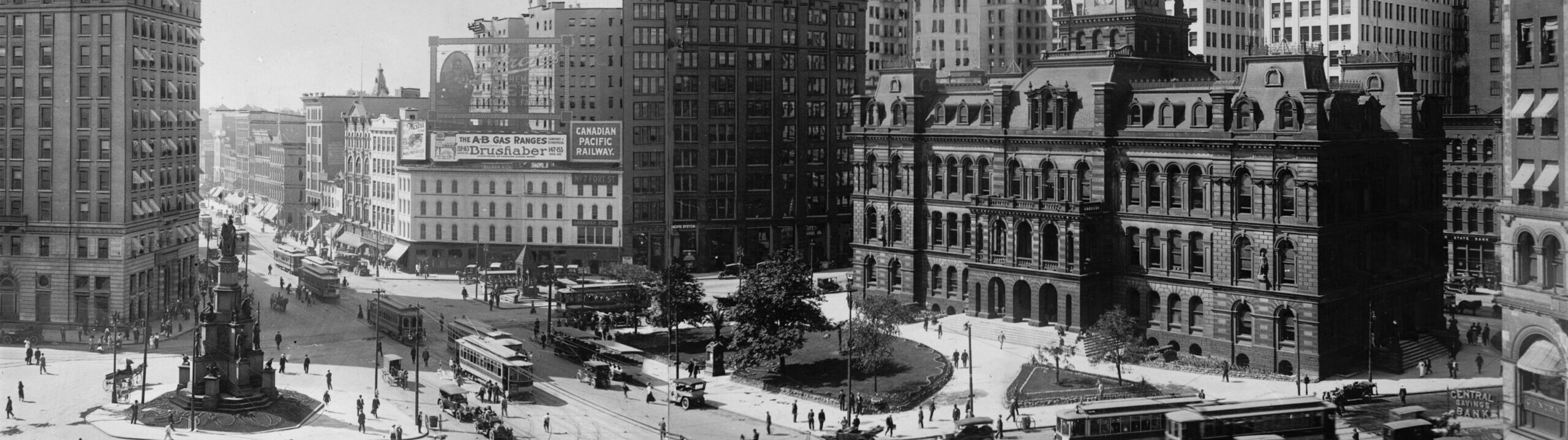
During the Second World War, the United States became the armory for the allied forces. To facilitate this, factories in the manufacturing industry were retooled to build weapons or other wartime materials. Detroit’s factories were no exception, the city’s well established automotive industries were well suited to the task, and greatly assisted in creating the Arsenal of Democracy. But how did the US facilitate the intersection between private industry, and federal policy of supplying arms to foreign allies?
In 1942, President Roosevelt established the National War Labor Board (WLB) to arbitrate in every industry, except agriculture, between employers and their workers, unionized or not.1 The primary goal of the WLB was to prevent work stoppages related to wartime manufacturing from occurring, and utilize their authority to end them if and when they did.1 To analyze the effectiveness of the WLB in Detroit however, we will need to employ the assistance of historical data.
As the chart suggests, the blue columns represent strikes where the WLB was not involved in arbitrating, and the green columns represent strikes where the WLB was assisting in arbitrating. Once the WLB began operations in 1942, the organization was hard at work keeping strikes and work days lost to a minimum, a task to which, as the chart would suggest, the WLB was well suited. Comparing strikes prior to the WLB’s creation to those which the WLB was involved clearly shows an effective organization.
To examine further we can take these same strikes and analyze their resolutions, which yields similar results. The WLB aided in the resolution of 30% of the strikes in Detroit from 1937 to 1945, with the rest being either ceased by the unions themselves, reaching an agreement to improve work conditions and wages or recognize a proposed union. This data comes as no surprise given the authority and power the WLB wielded–as the WLB had a say in the wages, hours, and working conditions of important manufacturing industries so that stoppages could be avoided and ended swiftly.2
Finally, if we examine the number of employees involved in labor stoppages in Detroit during this period, we can see the volume with which the WLB dealt. From this graph it is difficult to determine if there was a threshold of workers involved before the WLB got involved, especially since the original data used to create this graph does not contain useful data for stoppages involving less than 10,000 workers. In any case, the above chart is instrumental in illustrating the massive scale which the WLB dealt with, and the finesse necessary to arbitrate on behalf of many thousands of individuals.
The National War Labor Board effectively arbitrated in the war effort, and kept production in Detroit flowing to keep arms and necessary wartime resources in allied hands. We can see this clearly in the data from the column chart, showing the reduced number of days spent in a stoppage or strike. The pie chart reveals the success seen by the WLB over the other most popular solutions. Lastly the line chart helps contextualize the scale of the strikes and stoppages the WLB arbitrated, and impresses yet further how effective the board was under such strenuous circumstances–advocating and compromising on the behalf of thousands of workers.
References
Schatz, Ronald W. 2014. “‘Industrial Peace through Arbitration’: George Taylor and the Genius of the War Labor Board.” Labor: Studies in Working Class History of the Americas 11 (4): 39–62. doi:10.1215/15476715-2801085.
US Department of Labor. Work Stoppages: Motor Vehicles and Motor Vehicle Equipment Industry: 1927-1958. By James P. Mitchell, Ewan Clague, Washington, D.C.: Bureau of Labor Statistics, US Government Printing Office, 1959. https://babel.hathitrust.org/cgi/pt?id=uiug.30112101927975&view=1up&seq=1 (Accessed October 19, 2022)
